Four to eight hours per site
Downloading, naming, searching, copying, and reconciling a single site file commonly consumes half a day before design starts.
STA 0+00 · Why this exists
Downloading, naming, searching, copying, and reconciling a single site file commonly consumes half a day before design starts.
A discharge value is meaningless without its permit sequence, node, storm, scenario, datum, and source page.
The paid value is the synthesis: what the record establishes, which values are historical benchmarks, where documents conflict, and what must be confirmed before design.
STA 2+50 · How it works
Intersection is used for discovery, never as proof of parcel applicability.
Each permit action is tied to its permits, staff reports, calculations, plans, RAIs, as-builts, and completion records.
Storm, scenario, node, datum, asset, sequence, and source stay attached to each value.
Recorded baselines, calculated relationships, conflicts, and open conditions — each tied to evidence.
STA 5+00 · The deliverable
A concise engineering brief answers the kickoff questions. Its permit-lineage table, indexed source register, and cited record remain behind every conclusion.
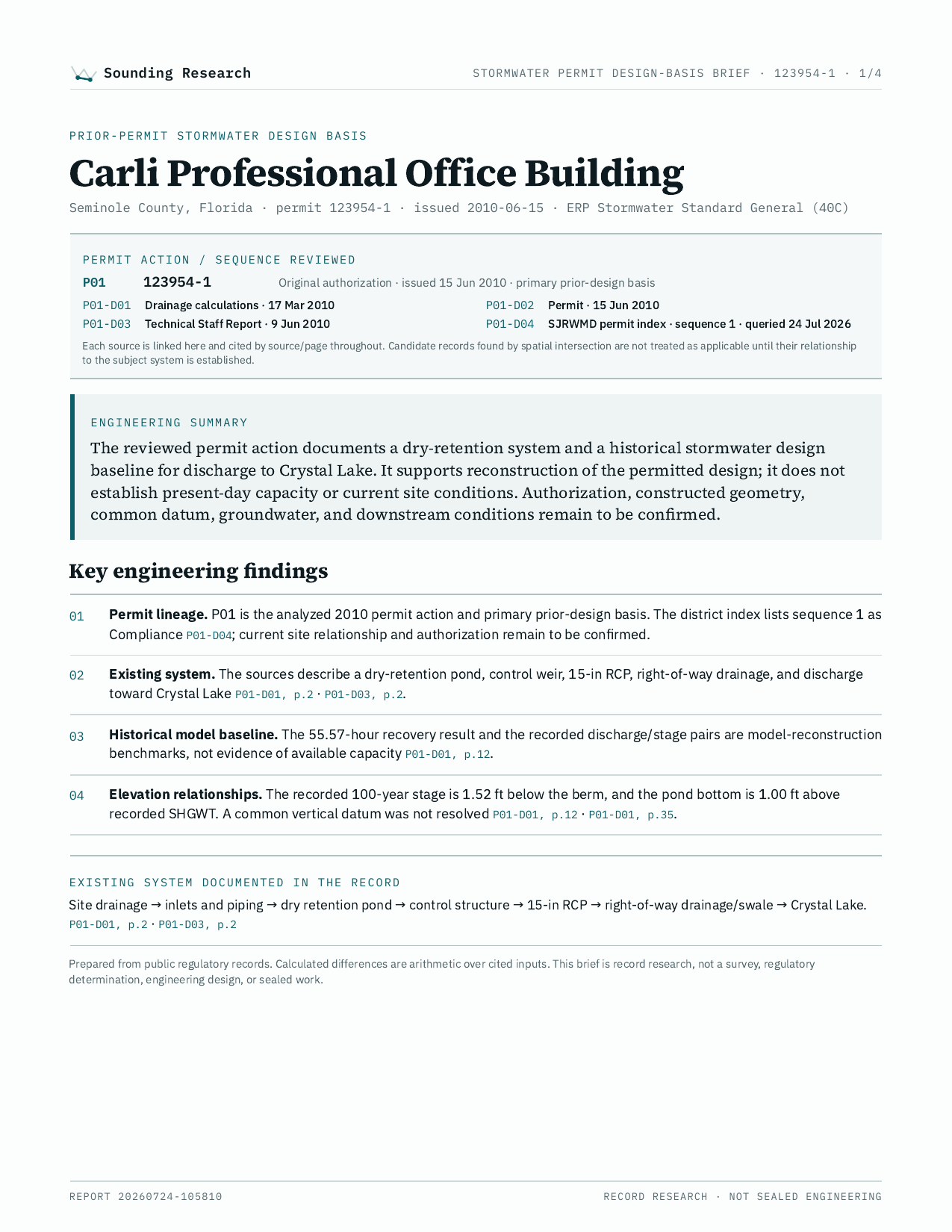
Record values are normalized by scenario, cited to source pages, and paired with engineering interpretation.
Each action gets a stable source group; each cited document gets a source ID that follows its values through the brief.
A field-verification checklist for the infrastructure the new design must find, protect, or replace.
Each open item states why it matters and how an engineer can resolve it.
Alongside the brief: a normalized workbook/CSV, supporting record, permit-lineage table, and indexed source register.
STA 7+50 · How the reading happens
AI-assisted extraction and reconciliation reduce the file work. The deliverable is an evidence-backed engineering briefing, not a list of search results.
Every value keeps its permit sequence, document, page, and engineering context.
Criteria, results, elevations, and system details are checked together, with conflicts kept visible.
The brief separates documented baselines from present-day conditions that still require confirmation.
The public sample uses real district records. Every reported value is cited, and every derived value is identified as a calculation.
STA 10+00 · Start
Draw or upload a boundary. See the intersecting district records and a firm price. Free, no account, no meeting.
Scope a siteAlready researched the site by hand? Send it. A side-by-side time and finding check is the best product test.